
Opens in a new tab

Same‑week appointments in Derby & Long Eaton.

Shoulder pain — causes, fixes & when to see a physio

Whether it’s a sharp catch lifting your arm, night pain that disturbs sleep, stiffness reaching behind your back, or aches after sport, we’ll help you understand what’s going on and get you moving again.

Rachel Royer

Reviewed by Rachel Royer, HCPC-registered physiotherapist and CSP member

Woman sitting up in bed holding her painful shoulder

Quick answers

  • Should I rest completely?

    Not usually. Relative rest + gentle movement is better than immobilising the shoulder (unless advised after injury).

  • Do I need a scan straight away?

    Often no. Many shoulder problems improve with time and a targeted rehab plan. Scans are considered if symptoms persist, red flags are present, or surgery is being considered.

  • How long until it improves?

    Many flare‑ups settle within 6–12 weeks with the right plan; frozen shoulder can take longer but still improves in stages.

Common symptoms and patterns

  • Pain lifting the arm (e.g., into a cupboard or overhead), often with a painful arc.
  • Night pain when lying on the shoulder; difficulty finding a comfortable position.
  • Stiffness reaching behind the back or fastening a seatbelt/coat.
  • Clicking or catching with certain movements; weakness with lifting.

Try this now: safe self-care

Do

  • Short bouts of movement: gentle pendulum exercises, wall slides, and elbow‑supported active‑assisted elevation.
  • Start scapula and rotator cuff work in a comfortable range (e.g., isometrics, light band work) 2–3×/week.
  • Use simple analgesia if appropriate and support the arm for sleep with a pillow.

Avoid (for now)

  • Repeatedly forcing painful arcs overhead or heavy lifting in aggravating positions.
  • Relying on passive treatments alone; exercise + education drive outcomes for most shoulder pain.

If you’re unsure, book an assessment — we’ll tailor this to your goals.

Book an assessment

When to see us

  • Pain that isn’t improving after 7–10 days of sensible changes.
  • Night pain, marked stiffness, or weakness that limits daily tasks.
  • Post‑injury pain with loss of function (e.g., can’t lift arm after a fall).

Ready to get moving?

Same-week appointments at Long Eaton, Pride Park, and Kedleston Road. Prefer to be seen at home? We also offer home visits across Nottingham & Derby. Book an appointment online or call 0115 972 1319.

How we help

  1. Step 1: Assess

    Movement and strength tests, special tests for rotator cuff/biceps/AC joint, and screen for neck or nerve involvement.

  2. Step 2: Plan

    Progressive loading (mobility → cuff/scapula strength → overhead capacity), pacing and flare‑up strategies; sleep and work/sport modifications.

  3. Step 3: Return

    Criteria‑based progress back to lifting, work and sport; clear home programme.
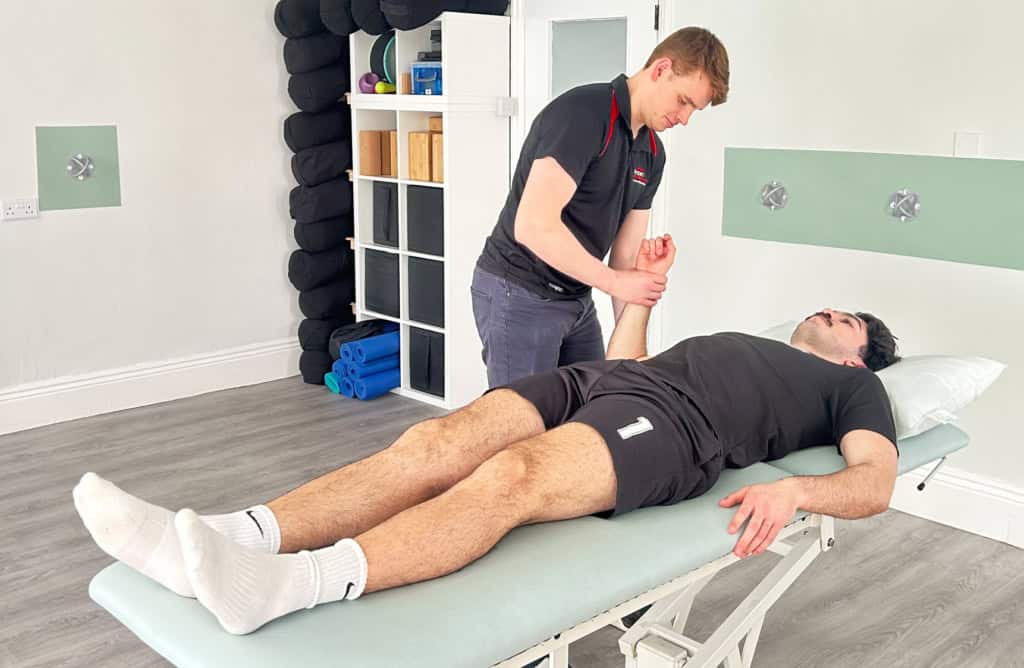
Physiotherapist raising a patient's arm to assess his shoulder

We also offer PhysiotherapyAcupunctureMassage as part of your plan — always alongside active rehab.

Did you know? We also run Pilates, Yoga and Strength & Conditioning classes at our Long Eaton clinic, and Tai Chi in Toton.

Shoulder conditions and symptoms

  • Likely causes

    Sensitive tissues in the subacromial space (rotator cuff/bursa) + reduced capacity/control. Usually not serious and responds to graded loading.

    What helps

    • Support the arm for sleep (pillow); avoid repeatedly forcing painful overhead arcs.
    • Gentle pendulums, wall slides, and isometric cuff holds in a comfortable range.
    • Keep cardio going (walk/cycle) and continue lower‑body training.

    How physio helps

    • Identify aggravators (range, load, repetition) and rebuild capacity with cuff/scapula strength. Manual therapy can help symptoms alongside exercise.
    • Progression plan: pain‑tolerant range → increase time‑under‑tension → introduce overhead range → return to pressing/lifting.

    Quick questions

    Do I need a scan?
    Not typically at the start. We consider imaging if progress stalls after 6–8+ weeks of good rehab, after significant trauma, or if there are red flags.
    What exercises are safest early on?
    Pendulums, supported elevation on the wall, isometric external rotation at the side, scapula setting, and light rows with elbows below shoulder height.
    Can I keep training?
    Yes, with modifications: swap barbell overhead press for landmine or incline press; neutral‑grip rows; avoid repeated painful arcs.
    How long will it take?
    Many improve in 6–12 weeks. We measure function (reach, sleep, daily tasks) as well as pain.
    Will taping help?
    Sometimes for short‑term confidence or busy days; it’s an adjunct while you build strength/control.

    Ready to get moving?

    Book onlineCall 0115 972 1319
  • Likely causes

    Overload of rotator cuff tendons relative to capacity; sometimes age‑related tendon changes. Tendons respond to load given time and progression.

    What helps

    • Reduce provocative lifts short‑term; start isometric cuff work (external rotation at side, abduction into wall), then progress to slow, heavy resistance as tolerated.
    • Support the arm for sleep; brief heat before exercise can ease into movement.

    How physio helps

    • Tendon‑loading plan with progress markers (pain‑guided loading, rep targets, tempo control), plus sleep and activity strategies. Many cuff tears (especially degenerative) do well without surgery.

    Quick questions

    Is rest enough?
    Rarely. Tendons need progressive load to adapt; total rest can reduce capacity further.
    How heavy is “heavy‑slow”?
    We’ll choose a load that feels challenging by reps 6–8 while staying within acceptable pain; 2–3 sets, slow tempo, 3–4×/week.
    Will I need surgery?
    Often not. Surgical opinions are considered for large traumatic tears with persistent loss of function or if high‑demand goals aren’t achievable after thorough rehab.
    Can I still sleep on that side?
    Try the opposite side hugging a pillow or back‑lying with a pillow under the arm to offload tissues.
    Timeline?
    Meaningful change often appears over 8–12+ weeks; full strength for overhead sport may take longer.

    Ready to get moving?

    Book onlineCall 0115 972 1319
  • Likely causes

    Capsular inflammation and stiffness. Typically progresses through painful → stiff → recovery phases.

    What helps

    • Keep the shoulder gently moving within tolerance; support for sleep; short heat packs can help comfort.
    • Practise everyday reach in micro‑bursts (hand to pocket, to belt, to shelf) without forcing range.

    How physio helps

    • Education on phases and pacing; mobility + graded strength plan; options like hydrodilatation or injections can be discussed with your GP/consultant alongside rehab.

    Quick questions

    How long does it last?
    Often 6–18+ months in phases, with steady improvement. We protect function and comfort while range returns.
    Should I force it?
    No. We prefer pain‑guided progress; aggressive end‑range stretching can flare pain without improving outcomes.
    Do injections help?
    They can reduce pain in some cases, especially early, to enable rehab. We’ll decide jointly if appropriate.
    Can I work and exercise?
    Usually yes with modifications (task height, lowered resistance). We’ll give a phased plan for daily tasks and gym.
    Sleep tips?
    Back‑lying with a pillow under the arm or opposite‑side lying hugging a pillow; avoid end‑range positions while it’s irritable.

    Ready to get moving?

    Book onlineCall 0115 972 1319
  • Likely causes

    Sprain or irritation at the acromioclavicular (AC) joint; may follow impact or repeated heavy loading.

    What helps

    • Short‑term deload of aggravating lifts; isometrics and pain‑free range work; experiment with neutral/close‑grip pressing.
    • Ice or compression after activity if it helps symptoms.

    How physio helps

    • Gradual return to press and overhead work with range → load → tempo progressions; tape/brace for short‑term confidence if needed.

    Quick questions

    Do I need an X‑ray?
    Consider after trauma if deformity or severe pain persists; otherwise not routinely.
    What pressing variations are friendlier?
    Incline, neutral‑grip dumbbells, and floor press often feel better early on; avoid heavy cross‑body end‑range until calmer.
    When back to gym?
    Start with pain‑free ranges, then increase load weekly as tolerated; keep reps controlled and avoid “bounce” at the bottom.
    Will it come back?
    Good cuff/scapula strength, sensible load progressions and variety in pressing angles reduce recurrence.

    Ready to get moving?

    Book onlineCall 0115 972 1319
  • Likely causes

    Irritation of the long head of biceps tendon at the shoulder.

    What helps

    • Briefly ease repetitive aggravators; start isometrics then progress to eccentric/concentric strengthening (curl variants, supination work) in comfortable ranges.
    • Adjust grip width and elbow position to find a friendlier path.

    How physio helps

    • Identify patterns (grip, elbow position) and build a tendon‑loading plan with clear progressions; integrate scapula/cuff support.

    Quick questions

    Is rest enough?
    No — tendons need load to adapt; we’ll dose it so symptoms remain acceptable while strength grows.
    Strap/tape?
    Can help short‑term confidence; it’s an adjunct to strengthening, not a replacement.
    Can I keep training?
    Yes — we’ll modify curl angles, tempo and volume; reduce provocative carries temporarily; keep legs/core training going.
    How long?
    Expect steady gains over 8–12+ weeks; stubborn cases may take longer but still improve with consistent loading.

    Ready to get moving?

    Book onlineCall 0115 972 1319
  • Likely causes

    Laxity or previous capsule/labrum injury leading to reduced stability.

    What helps

    • Avoid high‑risk positions short‑term; begin closed‑chain control work and scapula/cuff strength.
    • Practise isometric holds in safer ranges to build confidence.

    How physio helps

    • Stability programme focused on control in vulnerable ranges; criteria‑based return to sport. Surgical opinions are considered for recurrent dislocations or persistent instability despite rehab.

    Quick questions

    Can I return to sport?
    Often yes with a staged programme and objective criteria (strength ratios, control drills, apprehension tests).
    Do I need a brace?
    Sometimes for confidence in early stages or contact sports; long‑term focus is on muscular control.
    Will it always feel unstable?
    Many improve substantially with targeted strength and control; persistent instability after good rehab warrants an orthopaedic opinion.
    Throwing/overhead tips?
    We’ll rebuild scapula control, rotator cuff endurance, and overhead range gradually, then layer in power and sport‑specific drills.

    Ready to get moving?

    Book onlineCall 0115 972 1319

Insurance and funding

We work with all major private health insurers, including Bupa, AXA, Aviva, Cigna, WPA and HCPA. Please check your policy for physiotherapy cover and, if needed, ask us for our provider/registration details.

We also hold NHS contracts for services in primary and secondary care.

Prefer to self-fund? You can pay for your own sessions — we’ll explain options and provide clear pricing.

See our fees
  • Bupa
  • AXA
  • Aviva
  • Cigna
  • WPA
  • HCPA

What our Shoulder patients say

  • I had developed a sore shoulder caused by too much swimming. Rachel was brilliant and as well as treating it, gave me some excellent exercises to strengthen the area. Pleased to say the problem hasn’t returned and I’d definitely recommend anyone with a niggle to book a visit!

    MP

    Long Eaton

  • I injured my shoulder with a suspected torn rotor cuff (no idea if I’ve spelt that correctly). It was painful all the time and kept me awake at night. Chris my physio gave me simple exercises and treatment and it has so drastically improved my shoulder, I barely notice that there’s anything wrong with it. Chris is very knowledgeable, which has not always been my experience of physios.

    LP

  • I was diagnosed with a frozen shoulder. Alan the physio really helped me. He put me at ease from the first appointment. He helped me to get back a good standard of living, as I was struggling to do even some simple tasks. The receptionists were always friendly and helpful and sent me helpful appointment reminders.

    HB

  • I was having problems with a torn tendon in my shoulder which was causing a lot of discomfort, but after a few appointments with Danni at Impact Physio and being prescribed several exercises, I am now free from pain and able to do all the day to day jobs I was unable to do before. I would definitely recommend Impact Physio.

    EL

  • Many thanks to Fiona, the daily shoulder exercises were easy, realistic and very effective. Having an exercise program specifically designed for me, that changed in line with my progress, certainly helped greatly. Thanks again.

    Bob Walker

Shoulder pain: your questions answered

Book an appointment
  • Not usually at first. Most shoulder problems are diagnosed clinically and respond to targeted rehab. We consider imaging if: symptoms don’t improve after a sensible period of good rehab (often 6–8+ weeks), there’s significant trauma (suspected fracture/dislocation), there are red flags (fever with redness/heat, unexplained weight loss), or there’s marked weakness after an injury suggesting a sizeable rotator‑cuff tear. Imaging supports decisions; it rarely replaces a good assessment.

  • Keep it moving within comfort. Short‑term adjustments are fine, but prolonged immobilisation can slow recovery. Use pendulums, supported wall slides, and gentle isometrics; for sleep, place a pillow under the arm or hug a cushion to reduce night pain. Avoid repeatedly forcing painful arcs overhead early on.

  • Timelines vary with the condition and irritability: impingement‑type/cuff overload often improves in 6–12 weeks; tendinopathy usually needs 8–12+ weeks of progressive loading; AC joint grade I–II sprains can settle in 2–8 weeks with the right progressions; frozen shoulder follows phases and may take 6–18+ months but improves over time. We’ll measure progress with function (reach, sleep, lifting) as well as pain.

  • Often yes, with modifications. Early on, pick pain‑tolerant ranges (e.g., incline press, neutral grip, elbows slightly in front of the body), reduce load, slow the tempo, and limit overhead work. Keep cardio and lower‑body training going. We’ll map a return‑to‑overhead pathway (e.g., landmine press → half‑kneeling press → light overhead press) when ready.

  • Sometimes considered for short‑term pain relief in subacromial pain or frozen shoulder. Injections are best used to enable rehab, not as a standalone fix. Options like hydrodilatation for frozen shoulder can be discussed with your GP/consultant where appropriate.

  • Often normal if it’s painless. Many shoulders click as tissues move; we focus on comfort and function. Painful catching with weakness after a trauma needs assessment; we’ll screen for cuff or labral injury.

  • After a fall or impact with deformity or inability to move the shoulder (suspected dislocation/fracture), if the shoulder is red/hot with fever, or if you develop new numbness/tingling/weakness in the arm or hand. Seek urgent medical advice.

  • Usually not. Many cuff tears (especially age‑related/degenerative) and impingement‑type pains improve without surgery. Referral is considered for large acute traumatic tears with persistent functional loss, recurrent instability that doesn’t respond to rehab, or specific labral injuries in overhead/throwing athletes.

  • On your back with a pillow under the arm, or on the opposite side hugging a pillow so the sore shoulder rests forward and supported. A small towel under the upper arm can reduce night pain. Try to keep the shoulder slightly away from end‑range while it calms.

  • Bring tasks closer to the body, use a step or lower shelf instead of frequent overhead reaching, share or split loads, and schedule micro‑breaks for gentle shoulder movement. At a desk, keep mouse/keyboard close, forearms supported, and vary positions through the day.

  • Posture/technique can influence symptoms, but capacity (strength/endurance) and training load matter more. We’ll fine‑tune technique where it helps and build the capacity to tolerate real‑life positions.

  • Short‑term taping or a soft support can improve confidence and sleep during a flare. We aim to wean supports as strength and control improve. Long‑term reliance is not the goal.

  • Simple function markers (e.g., pain‑free reach to cupboard, side‑lying sleep duration, press weight/reps, work tasks) plus symptom change. If progress stalls, we’ll adjust the plan or discuss onward options with your GP.

Who you'll see

Our team includes HCPC‑registered physiotherapists and CSP members with experience in shoulder rehab for work, daily life and sport. You’ll get a clear diagnosis, a plan that fits your life, and support back to the things you love.

Clinics and booking

Book online in three steps.

  1. Choose your clinic
  2. Choose Physiotherapy (or a named physio)
  3. Pick a time

Long Eaton

128 Derby Road, Long Eaton, Nottingham NG10 4ER

Our Long Eaton clinic is our main hub, we offer individual physio appointments and classes in our Pilates studio.

Mon-Fri: 8am – 8.30pm
Sat: 10am – 1pm


View on map (Long Eaton)Book at Long Eaton

Pride Park, Derby

Derby Arena, Royal Way, Derby DE24 8JB

Our Pride Park clinic is inside the iconic Derby Arena. Especially convenient for businesses on Pride Park.

Mon: 10am – 4pm
Tue: 8:30am – 4:30pm
Wed: 5pm – 7pm
Thu: 8am – 12pm
Fri: 7am – 4:30pm


View on map (Pride Park)Book at Pride Park

Classes run at Long Eaton (Tai Chi in Toton). See classes

Book onlineCall